If you would like to read the first part of this discussion, click here. As I said I would, I recently finished reading the first book in the series His Dark Materials, by Philip Pullman. The movie version of The Golden Compass will be released in U.S. theaters this coming Friday. I’m going to see it sometime in the next few weeks. I’ve already begun reading book 2, The Subtle Knife. My plan is to give a short review (yes, I’m capable of that) as I finish each one.
I was going to give a synopsis of the book, but you can read that for yourself at a number of places on the web. Google is an amazing thing. I think what you really want to know, if you’re a friend or were part of the previous discussion here, is whether or not I give the book a thumbs up or down and why. So here’s my answer with an explanation based on my reading of the first book in the trilogy.
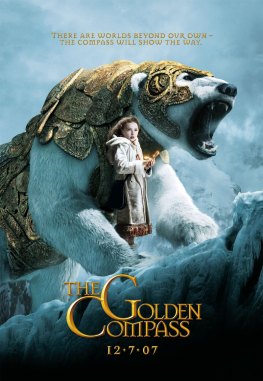
I give the first book a thumbs up…for teens or older. In my opinion, this book is not for children. Where I don’t believe this book is the evil thing many Christians are making it out to be, I do think there are too many dark elements to the story that could be damaging to little minds not ready to be challenged in that way. It is clearly fantasy fiction and I don’t think it is teaching young kids to be atheists. My children are simply too young to read it. The language alone would be difficult for kids to comprehend. What child do you know that uses words like “sardonic” or would know what “Tokay” is? Yes, mine are way too young. That is my call as their parent. When they are older and ready to have real and serious discussions about the subjects raised in this book, maybe we’ll read it together and discuss it. I’m all for that. Until then I will have to endure their disappointment and comments about how cool the movie trailer looks and how badly they want to see it. We’ve already done that for Harry Potter, so they should be used to it by now. Age appropriateness is important to me, as well as content. It’s more important than any marketing campaign trying to win people over to one side or another. One Amazon.com reviewer spoke it eloquently when they said, “Nothing will shape a child’s philosophy more strongly than their upbringing.”
So here are my thoughts on what I liked:
The concept of the daemon. Though I don’t like the word he chose, it’s probably fitting in the “companion” sense. I find it intriguing that in this story, every human has an animal version of themselves as a constant companion. The daemon represents characteristics of the person it is attached to. It can change shapes until the person (child) reaches puberty then takes on a single form. You can tell a lot about a person based solely on their daemon. For example, Asriel’s daemon is a snow leopard -attractive, powerful, confident, strong, and and a little dangerous -just like Asriel himself. It reminds me of growing up and trying to figure out who I was and what parts of me I wanted to develop and what parts I wanted to forget about, or change. Don’t I still do that? When I was young I was less sure of myself and more willing to reinvent myself than I am now as an adult and a little set in my ways. For all of you wondering, the daemons in the book are not the same as demons in the Bible.
The alethiometer. How cool would it be to have a device that tells you the truth about the past and the future, about people and their intentions, and about yourself? The mystery surrounding why Lyra has the alethiometer and what course it will bring about in her life is half of why I liked this book. There are layers upon layers of meanings and the fact that Lyra learns to understand it when most of the adults in her world won’t even try without the owner’s manual, is intriguing to me. Again, it reminds me how as a child I was willing to believe, try, and work at something with a lot more determination than I have now. That seems backwards, but it’s true. The “golden compass” works by “dust” which is the conciousness, and culminated experiences of a person, which could explain why there is more on adults than on children. It’s quite the mystery. I think the original sin mentioned so often by critics in regards to this dust could be compared to the point at which Adam and Eve realized they were naked and clothed themselves. Not the actual sin of disobeying God as mentioned in the Bible’s creation story.
Though many of the adults in this story were out to get Lyra for their own personal gain, there were equally as many out to help her on her journey. My first favorite ones, the Gyptians, displayed so well the concept of family. I also liked the intertwining of different clans and species all centered on rescuing missing children and aiding Lyra the best they could with her own mission. I thought there were good lessons on teaching kids discernment in learning who you can and can’t trust. Not everyone who says they’re your friend is, and not everyone you fear is your enemy.
Second chances. I loved that Lyra reminds Iorek who he is deep down and who he was meant to be. She provides him with a way out of his current circumstances and a return to his true life, and in return gains a loyal friend which comes in VERY handy later on in the story.
The message of believing in something bigger than yourself and playing your part, completing your role in it all through difficulties, betrayals, and other setbacks and pains.
The distrust of a corrupt organization who was power-hungry and ignorant of some of the happenings under their own direction and control. They sought to manipulate and destroy all who believed differently than they did. I don’t believe it was representative of Christianity as we know it today, but of a corrupt church from ages past. Regardless of the author’s personal beliefs, I didn’t find that it was a church-bashing fest and a railing against religion in general.
What I disliked:
Some of the subject matter. I have a hard time with a story line about children being abducted for horrible, painful experiments. Many of those who were targeted for abduction were poor and thought to be “not as missed” from society. Who would miss a street kid, right? Despite their own involvement in these experiments, Lyra’s “parents” are horrified when they realize she has somehow become part of the target audience. There’s a double standard that it is o.k. for certain children, but certainly not their own.
Parents who are deceitful and would use their children for their own gain. Parents who are abusive and neglectful and don’t know how to parent at all. The flip side being that having parents like this isn’t the end of the world. Though it leads to great confusion and heartache, there are those who will love you and pull you through, teaching you the lessons your parents couldn’t or wouldn’t teach you themselves.
Lyra’s most useful skill is lying. With her parents being who they are, it’s no wonder she’s so good at it. It gets her out of many scrapes, and even saves her life. I just didn’t like it being offered as a useful trait and a good and safe option.
The misuse of power by the “church”, which I’ve already stated is not representative of Christianity in general as we know it today, although there may be churches out there like that. I don’t know. I think one of the best descriptions of the church in the book was given by my friend Deb when she said, “…the church in the books has almost nothing to distinguish it from the illustrious history of the Roman Catholic Church. Note that I didn’t say Christianity. My mental image of The Church of the books was oh.. the Catholic Church (governing body, not the ordinary average person) during the life of Galileo…it does bring into conversation religious issues. For those of you who are Christian, this series *might* be a useful one with older children, to read and talk about religion. Things like- what is the simple message of Christ? Do the religious leaders in the books exemplify that? In the real world, can you think of people or groups of people who are examples of Christ’s message, and ones who are like the Church in Pullman’s books?” To read the rest of her comment, please refer to the previous post.
Overall, I thought this was a good fantasy story filled with people and creatures working together on opposing sides: good vs. evil. It’s an age old theme and this story kept tipping the scale back and forth as to who was winning the battle. Which brings me back to the movie. I’m going to go see it even though I’ll probably be disappointed with it since I’ve read the book. The movie has a PG-13 rating, and though I sometimes doubt our current rating system, in this case I agree with it.
I will post my thoughts on the movie and the other two books after I’ve experienced them. In the meantime, let’s hear your thoughts…
Read Full Post »


 Sometimes I Write